precision technology. real world performance.

— straight answers. no smoke.
QUESTIONS.
ANSWERED.
The things farmers ask us most about tuning — answered plainly, before you talk to a specialist.
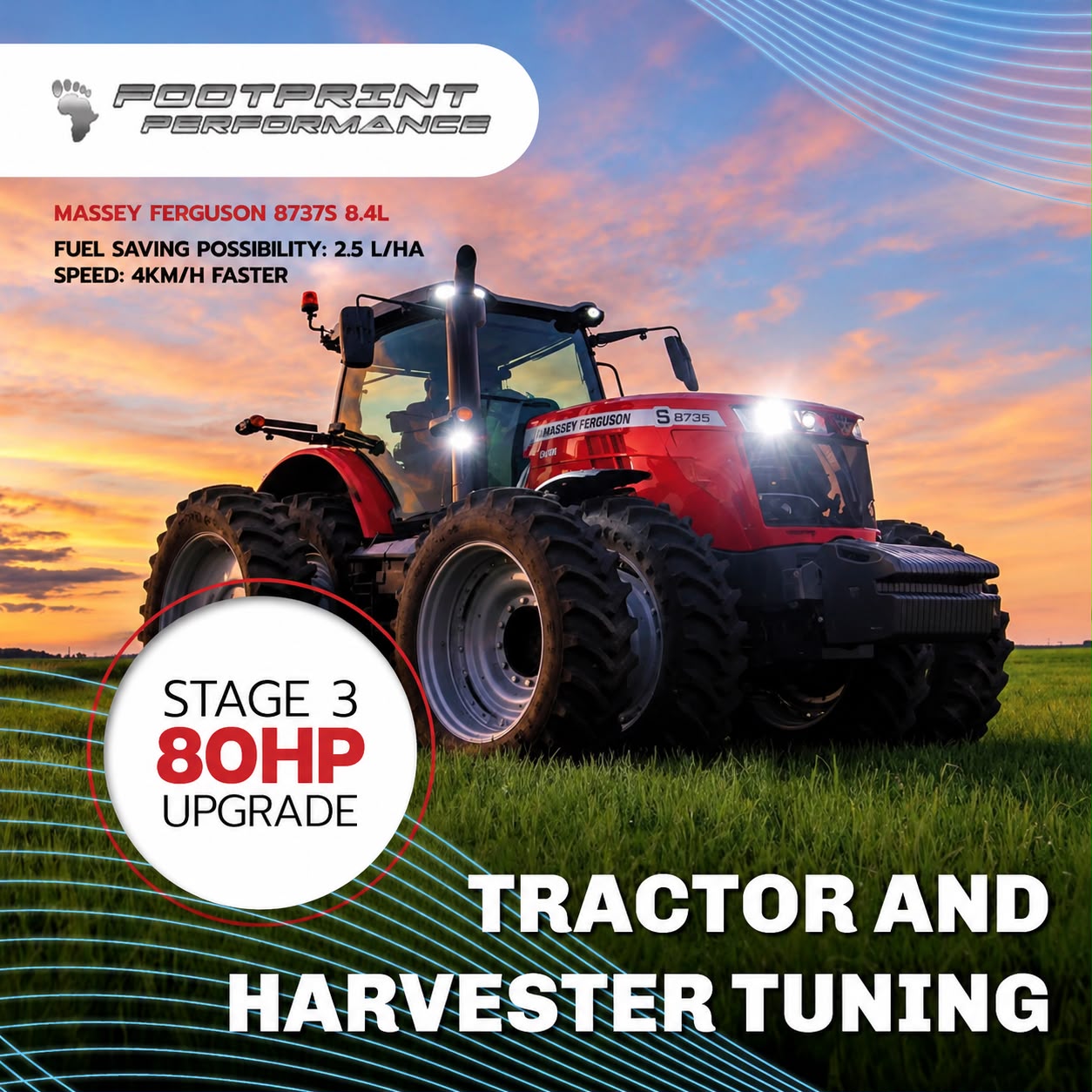
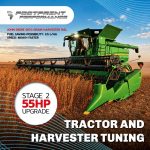
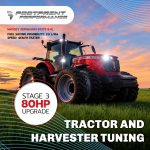
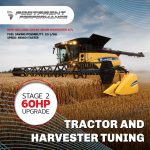
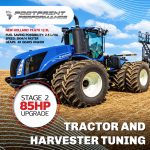
Sample Upgrades
These are just some of enhancements we can provide for your machine
Why use Footprint Performance?
We are entrusting the best possible tuning companies in the world to supply us to enhance
performance on your very expensive machinery. We choose the best option for each vehicle to
ensure that you get the best results on each individual vehicle.
All tractor and truck tunes have been developed and tested on a dyno testing station before being
released for production. AFR (Air Fuel Ratio) monitoring will be conducted on all tunes to ensure that
all files are within specification after being installed onto each individual machine.
More than 7 years of tuning experience and having been for training in Germany and New Zealand.
Footprint has very high insurance coverage (R31 million) against any possible damages that would be
caused directly by the tuning software/hardware. (Although we have never had to use this before).
Why do the vehicle manufacturers not carry out the tuning themselves?
The manufacturer develops a vehicle for the international market. In doing so, they must consider
various framework conditions such as national emission standards, regional differences in
temperature, different types of fuel or specific categories of insurances in different countries. This
means that an ex‐works vehicle needs to be equipped for a wide range of different influencing
factors. The adjustment of the above‐mentioned parameters to one single target market can
therefore be carried out only by tuning.
Tractor and Truck manufacturers sell trucks with the same engine and gearbox at much higher costs,
with the only difference being power delivery. This cost could be in excess of R2million just for more
power.
Does tuning Shorten Engine Life?
This depends on the degree of the tuning modifications. If no limit values are exceeded during
the software tuning and you have a “normal” style of driving, no increased wear is to be expected. If
the requested modifications deviate from normal standards and/or your driving style does not
comply to “normal” standards, the same signs of wear as the engine would be exposed to without
tuning are to be expected. Preventative maintenance services should still be conducted at same
intervals as prescribed by the manufacturer to prolong engine life. Do not use sub‐standard oils,
filters etc. as this would also shorten the service intervals.
Higher Performance, Lower Consumption! How does that work?
From a technical viewpoint, a reduction of fuel consumption is very often one of the benefits of
tuning. Fuel consumption is automatically lowered due to a shift of torque and the subsequent
driving at low engine speed. Of course, only if you stick to your normal driving style. After
tuning, your vehicle has the same power at a lower torque as compared to before with a higher
torque.
EGR Removal
EGR removal means to disable the exhaust gas recirculation valve. These valves enable exhaust gasses to get circulated into your inlet manifold to reduce emissions, but uses a lot of cooling to reduce excessive heat build‐up. EGR removal returns
around 25{34294cd9d8c8f3ab391a98fab11138536c4934d3e61f30495e3d8dccce91994c} of your cooling capacity to the engine which results in a much cooler, more efficient diesel engine.
High amount of water in Diesel always causes problems with the EGR valve or the EGR cooler creating a sticky mess in the exhaust line building up, and blocking flow over time. These problems result in a decrease of the engine’s lifetime and leads to
breakdowns. They are so subtle in clogging up that one do not notice the decrease in power or cooling capacity…until you disable the EGR.
Please read this independent article of what the EGR do
https://www.dieselnet.com/tech/engine_egr.php Through a disable of the EGR valve we avoid or even eliminate these problems.
DPF (Diesel Particulate Filter) Delete
As with EGR, a DPF filter is installed to remove soot from a diesel engine. This filter
work great on a new engine, but as time goes by it starts losing its effectiveness. It is
installed inside the exhaust line, and will get clogged up very quickly which will cause
your engine to run at higher temperatures than needed, causing your diesel truck to
lose power, and very likely cause a breakdown on the road, which will cost
thousands. A new DPF costs about $5,000, (R70,000). Deleting the DPF option from
the ECU will enable the removal of this filter without any more problems
whatsoever, at the fraction of the cost for a new filter. Your engine would be able to
properly breath again and get rid of unnecessary exhaust gas build‐up.
AdBlue SCR Urea Delete
SCR systems work by reacting to AdBlue with NOX(nitrogen oxide) gasses in the exhaust to form
water and nitrogen.
The driver must always ensure that there is an adequate supply of AdBlue in the
tank, as the vehicle will go into limp mode and even damage the SCR.
AdBlue consumption is about 5{34294cd9d8c8f3ab391a98fab11138536c4934d3e61f30495e3d8dccce91994c} of diesel use, therefor will use about 1.5 litres per
100km, which adds op already very high costs.
Entire SCR Urea System can be removed after software delete of AdBlue with no
fault codes
Cost saving
Making use of our products will ensure you achieve massive amounts of saving. Being it with diesel,
time saving and the ability to purchase a lower specked car, motorbike, truck or tractor and
afterwards increasing performance.
One such example is on a John Deere 8R series tractor. Below is listed the different models and
difference in power delivery.
John Deere 8320R – Standard HP, 320HP > Tuned HP, 865HP (+45HP)
John Deere 8345R – Standard HP, 345HP > Tuned HP, 390HP (+35HP)
John Deere 8370R – Standard HP, 370HP > Tuned HP, 407HP (+37HP)
John Deere 8370R cost roughly R1 million more than 8320R, although the 8320R can easily handle
the extra power gains to achieve same power delivery as the 8370R standard configuration. This will
also mean that heavier implements can be worked with using the same tractor, but with increased
power delivery.
ECO‐Tuning
The Best Method for Reducing Fuel Consumption
Tuning does not necessarily aim primarily at achieving a
better performance for your vehicle, as fuel consumption is
becoming an increasingly important issue when it comes to
chiptuning. In times of rising fuel prices eco‐tuning for diesel
engines is continually gaining in importance. The main aim of
eco‐tuning is that of achieving a reduction of fuel consumption.
By optimizing the software of the engine, its efficiency is adapted
so that fuel consumption can be reduced by up to 20{34294cd9d8c8f3ab391a98fab11138536c4934d3e61f30495e3d8dccce91994c} under
normal driving conditions. Further effects of eco‐tuning are an
improved overall performance and an improved
torque. However, the measures connected with eco‐tuning
focus on the degree of optimization to be achieved regarding
fuel reduction.
Will tuning void my tractor's warranty?
The tuning is fully reversible. We save a backup of your engine's original software before any change is made, and can restore it at any time — for example before a dealer service. Your tractor returns to factory settings without a trace.
When does eco‐tuning pay off? Who should consider tuning for fuel reduction?
Basically, eco‐tuning makes sense for anyone who drives many kilometres/hectares a year. The
general savings potential lies between 10{34294cd9d8c8f3ab391a98fab11138536c4934d3e61f30495e3d8dccce91994c} and 20{34294cd9d8c8f3ab391a98fab11138536c4934d3e61f30495e3d8dccce91994c}. The extent of improvement that can be
achieved depends mainly on the vehicle type.
Clients have been known to save as much as 4l/ha on a tractor.
Quickly calculated on very average figures;
When saving 2l/ha over 500ha, the saving would be R12,000. This would result in saving the amount
more or less than what the tune cost for this vehicle, and enabling huge savings in seasons to come.
The consumption of a BMW 530d is higher than that of a VW Polo, i. e. a BMW 530d has a much
higher savings potential.
ECO‐Tuning Definition
The term eco‐tuning refers to the possibility of using tuning in order to optimise the engine torque so that despite a lower engine speed the performance of the car remains the same as before (with higher engine speed). This leads to a reduction of fuel consumption. The engine becomes more efficient due to a higher and earlier torque and an advanced (earlier) injection time. Nevertheless, the driver has to cooperate after the completion of the eco‐tuning process.
By shifting to a higher gear earlier, tuning helps you to save an enormous amount of fuel with
no loss in performance. The larger torque of the engine enables the driver to enjoy a more powerful
car and gain more pleasure in driving.
What is the difference between EGR, DPF and AdBlue delete?
They are three emissions systems your tractor may carry. EGR recirculates exhaust gas back into the engine, DPF traps soot in a filter, and AdBlue injects urea fluid into the exhaust. Disabling the ones your machine doesn't need reduces soot, prevents filter and system faults, and lowers running costs.
Which tractor brands and models can you tune?
We work with John Deere, Fendt, New Holland, Case IH and more — from 6R and 7R series John Deeres to Tier 4 Fendt Varios and New Holland T6 to T9. See the model lists on our tractor tuning page, or send us your make and model and we'll confirm what's possible.
How long does a tune take and how is it done?
Most tunes are completed in a single visit or via a sent-in control unit, typically within a day. We read your engine's control unit, write a custom calibration matched to your workload, and verify the result with you before you head back to the field.
— STILL WONDERING?
ASK US ABOUT
YOUR TRACTOR.
Every machine is different. Tell us what you run and what you need from it, and we'll give you a straight answer.
LET'S TALK TRACTOR PERFORMANCE.
more from your machine.
less from your tank,